Redesigning Earrings Discovery for a Large-Scale Catalog
How restructuring 140,000 products around user intent drove a 2% increase in monthly revenue on Amazon.in.
The Challenge
Amazon.in's earrings catalog held 140,000 products. Most were invisible to the shoppers they were built for. Discovery was limited to rigid attribute filters such as gender, type, colour, metal. Over 100,000 products were incorrectly tagged. Browsing surfaces only amplified what was already popular, leaving emerging styles buried. A dedicated storefront was a rare window to rebuild how users find earrings entirely.
How do you make 140,000 earring products discoverable to a shopper who knows exactly what she wants to feel, but has no idea what to search for?
Company
Amazon India
Timeline
2018
—
2019
Role
UX & Product Designer
Work
Research · Information Architecture · ML Collaboration · Store Merchandising · Cross-functional Delivery

The Problem
The catalog was not small. The structure was.
62.5% of Indian jewellery customers buy earrings,
making it the largest
subcategory in a
540,000-product catalog.
The filters available? Gender. Type. Colour. Metal. Not one for occasion. Not one for style. Not one for face type. That is not how anyone has ever thought about buying earrings.
Underneath that was a harder problem. Over 100,000 products were incorrectly tagged - pearl earrings appearing under gold jewellery, fashion pieces buried inside traditional categories. Browsing surfaces highlighted only what was already popular, leaving emerging styles completely invisible. The catalog was not just badly structured. It was actively misleading the people trying to use it.
90% of earring shoppers browse. None of the navigation was built for them.
100 participants. A quantitative survey and behavioral analysis surfaced the gap the system had never acknowledged.
Users came to the platform with intent - a wedding, a first date, a mood. The platform asked them to navigate taxonomy. That translation was the first point of failure.
Visual display drove 75% of purchase decisions. Yet products were shown in isolation - no styling context, no occasion framing, no help imagining real-world wear.
Decision-making depended on occasion, personal style, and identity. None of that was reflected anywhere in the system.
Core Insight
The system was built around the wrong question.
Librarians asked: "What is this work?" Researchers were asking: "What work feels like mine?"
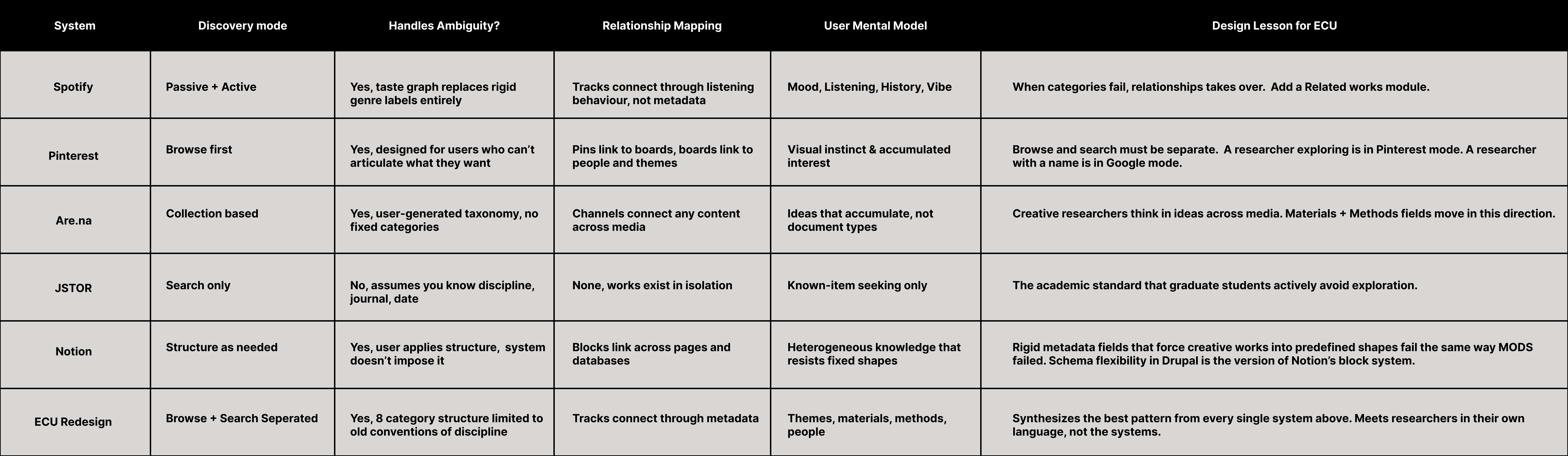
Researchers don't search by classification. They search by resonance, what a work touches, who made it, what ideas it sits near. The old system couldn't answer that. It described objects. Researchers were looking for connections.
That became the principle behind every decision that followed:
Stop describing works. Start connecting them.
Design Principles
Before touching the architecture, I turned the core insight into four constraints. Not values, constraints. Each one came from something that had broken in the old system. Each one became a test: does this decision honour the principle, or compromise it?
Speak the researcher's language
Categories mirror how researchers think, themes, materials, methods, not how metadata schemas classify objects.
Connections over containers
Works don't live in isolation. The system surfaces relationships between works, creators, and ideas. Rigid categories don't.
Built to be maintained
A taxonomy no one can sustain will decay. Every decision had to be operable by library staff, no metadata specialist required.
Flexible enough to hold what doesn't fit A textile-feminist-community-ritual thesis shouldn't be forced into one subject heading. Enough structure to be searchable; enough openness to not break under complexity.
Site Map
Applying these principles meant first understanding the full scope of what needed to change. The old system had no Creator, Material, or Method fields, 60+ flat subject tags, and records that went nowhere. The redesign added relationship-based fields, restructured taxonomy, and connected every record to related works.


Content Model
With the taxonomy restructured, the next question was how content types related to each other — not just what they were, but how they connected. The Navigational failure pattern (users hitting a dead end at every record) was a schema problem, not just a UI problem. The content model was built to fix that at the data level.
I developed the content model diagram to map relationships between content types. The full taxonomy vocabulary and field-level audit was developed in collaboration with the content strategist.

Information Architecture
To restructure the subject taxonomy, I ran card sorting sessions with graduate students, asking them to group 40 subject terms into categories that felt natural. The guiding question for each term was: what does this mean in the context of your research? — determining, for instance, whether "Textiles" belonged under Materials & Making, Identity & Culture, or Social & Political. The clusters that emerged became the 8 parent categories in the redesigned taxonomy.
The Information Architecture maps every facet across the system, marking what was renamed, restructured, or newly introduced.

Annotated Wireframes
With the architecture defined, wireframes were built to validate how the browse and search flows would work in practice — and to test the core hypothesis: that restructuring entry points around mental models, not metadata categories, would reduce abandonment.
Browse Flow
The Browse flow was for the researcher who arrives without a known destination. She has a theme, a feeling, a material — not a title or an author. 73% of users entered through the Topic facet but left without clicking a result.
Research finding that drives this: Users given a flat 60+ term list spent an average of 40 seconds scanning before giving up. Grid clusters reduced cognitive load and gave users a recognizable entry point.

Screen A — Browse Landing: 8 subject category cards displayed as a visual grid, not a dropdown. Each card shows the category name and a work count.
Screen B — Filtered Results: Filtered Results: User has selected "Materials & Making" and added "Ceramics" as a sub-filter. Results list with active filter chips at the top, a refine-by-Material sidebar, and a Sort control.
Screen C — Results: User selects "Ceramics" and lands on a filtered results list. Thesis records display as cards with thumbnail and metadata. The breadcrumb (Subject > Materials & Making > Ceramics) shows exactly where they are in the taxonomy and lets them step back one level at a time.
Search Flow
The Search flow was for precision. An advisor looking up a specific student. A researcher who already knows the name.
Research finding that drives this: author-name was the most common search query, yet no Creator field existed. The search experience was redesigned around that reality — Creator surfaces as the first filter, not buried in an advanced options panel.

Screen A — Keyword entered: Results for "textile." Filter panel on the left shows Creator, Subject, Medium, Method, and Format as collapsible groups.
Screen B — Filtered Search: User expands the Creator filter and selects a name. Breadcrumb updates to Graduate Theses > Textile. Research finding: users abandoned searches when they over-filtered and couldn't recover — individual filter removal solves this.
Screen C — Results: Both filters applied — Textile and Creator. Breadcrumb confirms the full path: Graduate Theses > Textile > Creator XX. 10 results returned as a card list.
Record View
Where the two flows converged was the record view — the individual thesis page. This became the most important screen in the system, and the place where the core insight had to show up most clearly: stop describing works. Start connecting them.
Research finding that drives this: users who reached a record either found what they needed immediately or abandoned entirely — there was no next step. Two design decisions responded directly to that dead end.
The Related Works module turns every record into a new entry point through shared tags. Rather than being a terminus, each thesis page becomes a continuation — a way to keep moving through the collection without returning to search. This was the single most important structural change in the system. It solved the Navigational failure at the UI level.
The clickable Author field surfaces every thesis by that creator from a single name. Finding one work by someone immediately opens their full body of work.

Screen A — Record Landing: Thesis title, creator name, and compound object preview above the fold. Summary section collapsed below.
Screen B — Persons & Affiliations: Metadata expanded to show Author and Thesis Advisor. Advisor name is hyperlinked — clicking it surfaces all theses supervised by that advisor, turning the record into a discovery entry point.
Screen C — Related Works: Identifiers, Access and Rights, and Subjects and Classification collapsed. Related Works module appears at the bottom as a card grid — theses connected by shared tags.
Screen D — Related Works Expanded: Full Related Works view. User can continue browsing connected theses without returning to search.
High Fidelity Prototype
The high fidelity prototype brought the collections interface to life across desktop and mobile with complete visual design, working filters, and a fully navigable grid.

Testing & Outcomes
User testing was conducted with 20 participants across graduate student and faculty profiles. Each session ran 90 minutes. Participants were given three tasks: find a thesis by a specific creator, explore works related to a given theme, and navigate from a single record to a connected work without returning to search.
Key findings:
Participants completed the browse task 73% of the time, compared to 23% on the old system.
Time spent scanning the subject taxonomy before selecting a category dropped from an average of 40 seconds to 20 seconds with the grid format.
The Related Works module was used by 70% of the participants without prompting.
Direct quote from a testing participant — I didn't feel like I hit a wall this time — I just kept finding more things.
The core hypothesis held: restructuring entry points around mental models — not metadata categories — reduced abandonment and kept researchers moving through the collection.
Reflection
This project started as a migration. It ended as a rethinking of what discovery means in a creative archive.
The old system asked: what is this work? The new system asks: what does this work connect to? That shift — from description to connection — changed the schema, the taxonomy, the navigation, and ultimately the experience of every person who enters the collection looking for something they can't yet name.
What I would do differently: The taxonomy was rebuilt collaboratively through card sorting, but the maintenance model — how library staff sustain it over time — was documented but not tested with the people who will use it. The next phase of this work would be a staff-facing audit workflow that prevents the taxonomy from decaying back into the state we found it in.
What remains open: Personalization. The system now surfaces connections between works. It doesn't yet learn from individual researchers. That's the next layer of the discovery problem.