The Challenge- Emily Carr University holds over 100 years of creative work — graduate theses, paintings, films, installations, critical writing. Students came looking for inspiration. Most left empty-handed. The system was built for academic publishing; creative research doesn't fit. A migration to Drupal opened a rare window — a chance to rebuild how people find things, not just where they're stored.
Company
Emily Carr University of Art & Design
Timeline
2024
—
2025
Role
UX & Product Designer
Discovery Research
Content Before designing anything, I needed to understand two things:
How other institutions handled this problem, and how researchers actually behaved inside the existing system.
Environmental Scan
I benchmarked digital collections across Canadian universities. The pattern was consistent: most systems were built for the library, not the researcher.
User Research
I interviewed 20 graduate students and faculty across Vancouver who actively used the collection for their own research.
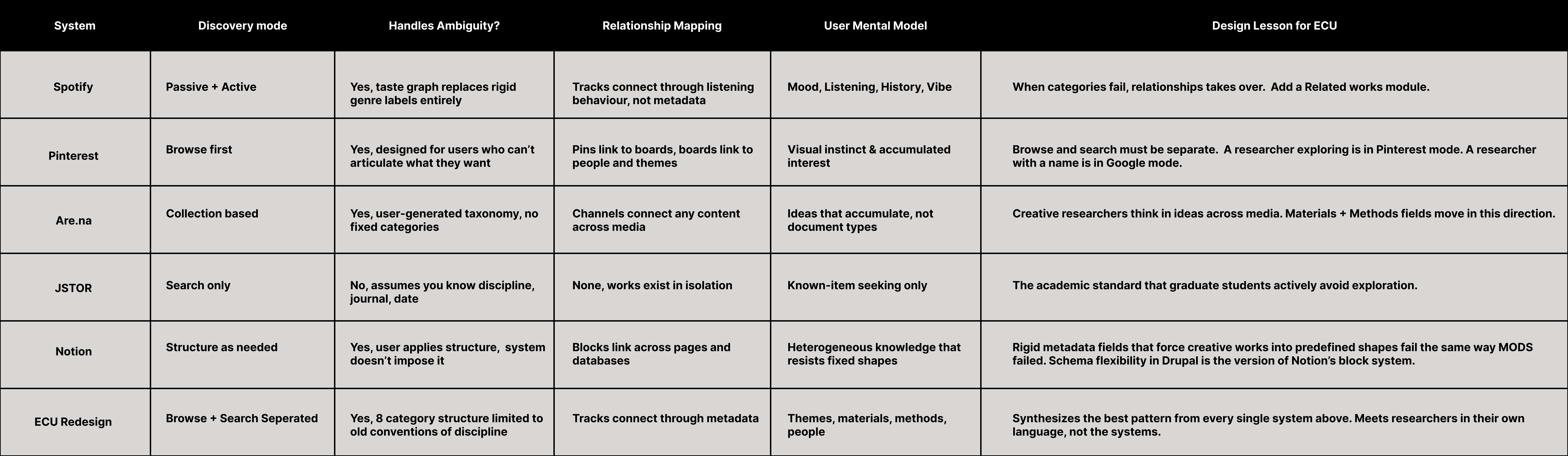
Alongside the collection, the participants were also using Spotify, Pinterest, and Notion daily, systems that solved the same discovery problem at a much larger scale.
User Flow

Figure 1: User Flow: Finding, Accessing, and Submitting Creative Work on the ECU eCollections Platform
Three failure patterns surfaced in every conversation
Organizational Systems
Topic was the primary entry point. Users searched by author. The Design taxonomy was incomplete, subject-based exploration was unreliable.
"I always search by name, but half the time nothing comes up."
Navigational Systems
Relationship fields were absent from the schema entirely. Users found one relevant work and hit a wall, no way to follow threads to related people or projects.
"There was no way to see what else that person had done."
Labelling Systems
The same concept appeared under different labels across records. Search terms returned inconsistent results.
"I searched 'textile' then 'textiles' and got completely different results."
"I looked beyond academic libraries, how Spotify surfaces undeclared taste, how Pinterest connects ambiguous intent to content, how Notion structures heterogeneous knowledge. The pattern across all of them: the best discovery systems meet users in their own mental models, not the system's."
Latest projects

Role
UX & Product Designer