Redesigning Earrings Discovery for a Large-Scale Catalog
How restructuring 140,000 products around user intent drove a 2% increase in monthly revenue on Amazon.in.
The Challenge
Amazon.in's earrings catalog held 140,000 products, and most of them were invisible to the shoppers they were built for. Discovery ran through rigid attribute filters: gender, type, colour, metal. Over 100,000 products were tagged wrong. Browsing surfaces just amplified whatever was already popular, so emerging styles stayed buried. A dedicated storefront gave us a rare shot at rebuilding how people found earrings from the ground up.
How do you make 140,000 earring products discoverable to a shopper who knows exactly what she wants to feel, but has no idea how to find it?
Company
Amazon India
Timeline
2018
—
2019
Role
UX & Product Designer
Work
Research · Information Architecture · ML Collaboration · Store Merchandising · Cross-functional Delivery
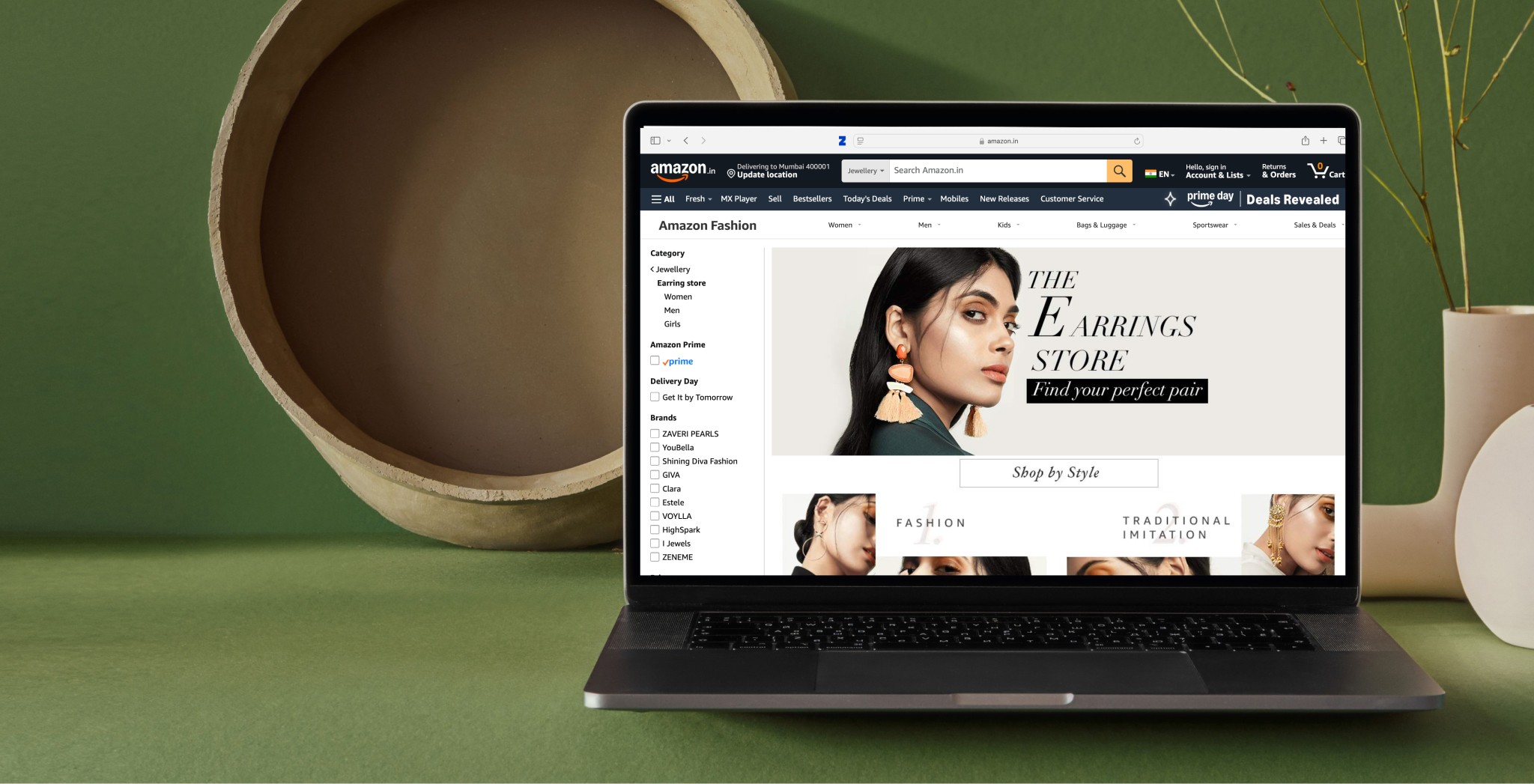
The catalog was not small. The structure was.
The filters available? Gender. Type. Colour. Metal. Not one for occasion. Not one for style. Not one for face type. That is not how anyone has ever thought about buying earrings.
Underneath that was a harder problem.
Over 100,000 products were tagged wrong: pearl earrings filed under gold jewellery, fashion pieces buried inside traditional categories. Browsing surfaces kept highlighting whatever was already popular, so emerging styles stayed invisible. The catalog wasn't just badly structured. It was actively misleading the people trying to use it.

Earrings
Neckwear
Rings
Jewellery sets
Others
62.5% of Indian jewellery customers buy earrings, making it the largest subcategory in a 540,000-product catalog.

90% of earring shoppers browse. None of the navigation was built for them.
100 participants. A quantitative survey and behavioural analysis exposed a gap the system had never owned up to.
Users came to the platform with intent: a wedding, a first date, a mood. The platform asked them to navigate taxonomy instead. That mismatch was the first point of failure.
Visual display drove 75% of purchase decisions, yet products were shown in isolation: no styling context, no occasion framing, nothing to help someone picture actually wearing it.


It Was Not Just Amazon
100 participants. A quantitative survey and behavioral analysis surfaced the gap the system had never acknowledged. Benchmarking Amazon, Flipkart, Nykaa, and Myntra revealed a category-wide failure.
Amazon led on brand filtering, which only helps if a shopper already knows what they want. For the 90% browsing without a brand in mind, every major platform failed the same way: no occasion browsing, no face-type filtering, nothing built around style as an entry point.
The gap wasn't specific to one product. It ran across the entire category, which made it a real opportunity.

Core Insight
Users weren't searching for what earrings are. They were searching for what earrings mean. The system described earrings as objects with fixed attributes, while users experienced them as extensions of identity and occasion.
What would I wear to a wedding? What suits my face? What feels like me right now?
Those were the real questions people were asking. The catalog answered back with metal, size, and earring type. Tweaking the filters wouldn't have fixed that. The information architecture itself needed to change.
Scaling the Fix with Machine Learning
The tagging problem was too big to fix by hand. Before building a better experience, the catalog itself needed repair, and machine learning was the only way to do that at scale.
Over 100,000 products miscategorized. Fashion jewelry filed as traditional. Pearl earrings listed under gold. The system's own data was working against it, and retagging all of it by hand simply wasn't realistic.
I worked with the ML team to retrain the tagging model. The initial version, trained only on product descriptions, came back weak. Text alone wasn't enough signal, and the first attempt landed at just 47% accuracy. The fix was adding product images to the training data. Accuracy jumped to 93%. Anything that fell below the confidence threshold got quarantined and flagged for manual review, so nothing got auto-tagged incorrectly. At the same time, I defined 23 occasion-based taxonomy labels, giving the catalog a shared discovery language that actually matched how people search and choose.

The Design
Wireframe: The redesigned information architecture replaced flat categorical navigation with three context-first paths.
Shop by Occasion aligned the catalog with real decision moments.
Shop by Style reflected personal expression.
Shop by Face Type answered a question users had always asked and no platform had ever directly addressed.
Scroll inside desktop to see entire wireframe.


High-Fidelity Prototype
The high-fidelity execution leaned into visual richness over information density: rich editorial imagery, contextual curation, craft-based browsing.
The goal was helping users picture themselves wearing an earring instead of just looking at one. Built for desktop and mobile with the same context-first logic throughout.

Testing & Outcomes
An A/B test validated the approach. The launch confirmed it.
The test confirmed what the research had predicted: when structure matches how people actually interpret and choose jewelry, behaviour changes.
The store launched. Monthly revenue went up 2%, a meaningful number at Amazon.in's scale. Discovery improved across more than 100,000 products, and the 23 occasion labels finally gave users entry points that matched how they actually shop.
Usability Testing Results
85%
engagement across discovery surfaces
New
Old
85%
38%
Users who engaged with discovery surfaces - A/B test
47%
93%
ML tagging accuracy
Text Description only > Text + Product Images
18%
CTR - Shop by Occasion
The highest performance discovery path.
Intent-based entry points outperformed all others.
100,000+
Products correctly tagged for the first time
across 23 occasion-based taxonomy labels
AB test Screens

Standard product listing with attribute-based filters and a popularity-driven product grid. 38% engagement across discovery surfaces.
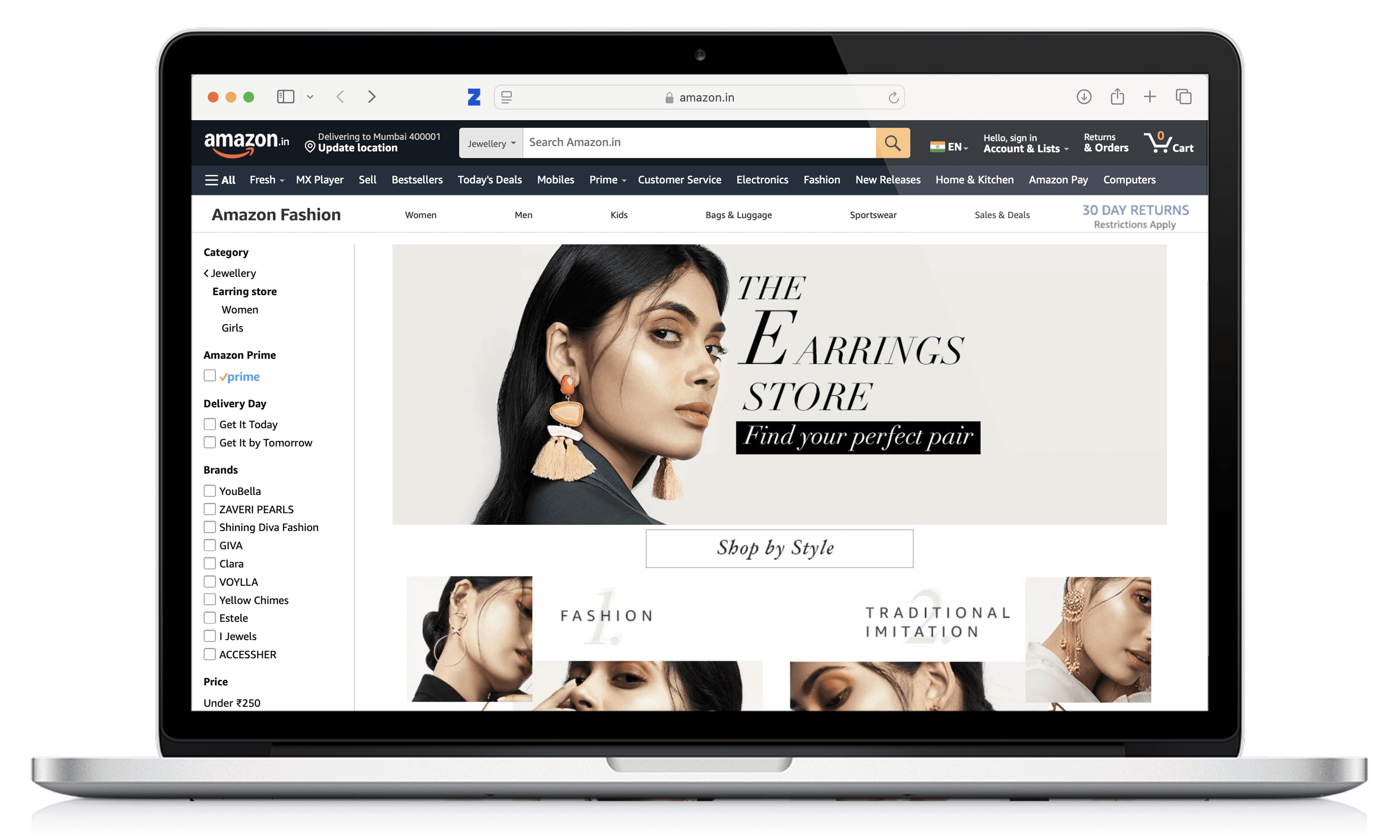
Context-first storefront with editorial hero, Shop by Style navigation, and occasion-led discovery. 85% engagement across discovery surfaces.

